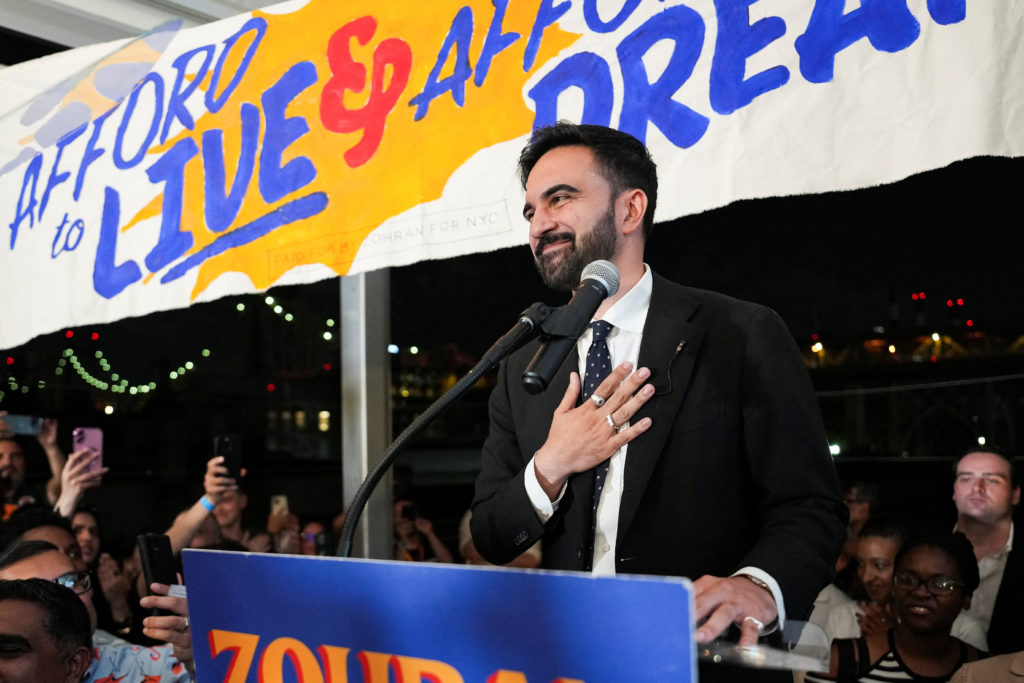
Following the colossal victory of Mamdani, Donald Trump posted, “And so it begins!” I am not sure when the last time I agreed with Trump was. Yes, and so begins a new age of politics because young Americans will now, as they did in New York, demand the “impossible.” That is what young New Yorkers did when they rallied around an outsider, Muslim and Democratic Socialist Zohran Mamdani, and, despite the overwhelming odds, won.
The victory signals a major crisis of hegemony because it inaugurated a new horizon of possibility. This was made possible, not because we defeated Andrew Cuomo, but because we defeated our own impotence: decades of false hope in two-party politics and our cynical reasoning.
We need to take a step back to realize that this is bigger than about Mamdani and Cuomo. It is about an evolving and generational shift in public attitude that can potentially create tectonic shifts in our political landscape. And so, the debates about whether Mamdani is really just another careerist Democrat misses the point entirely.
For the past two decades, political thinking and action seemed impossible in the face of the colossal powers of the corporate state. We were barred from politics, not through state violence, but through cynical reason: What can we do against these odds? The game is rigged. Election after election, the Democratic Party proved to be as complicit in empowering the corporate state, and as a result disempowering us, as the GOP. Yet, many still saw the Democrats as a lesser of two evils. What other options did we have?
The late Mark Fisher called this condition reflexive impotence. It occurs when we know that the system is bad but simultaneously believe that we cannot do anything about it. In turn, this lack of action prolongs the longevity of the state and perpetuates a sense of despair and self-imposed impotence. And yet, even outside of politics, the pursuit of “self-optimization” and “climbing up the ladder” was also rigged: there was no escape; the forces that crippled politics pervaded everything. Against such odds, what can we do?
But history proves that decades of inertia and repression do not necessarily breed docility, but quite the opposite. Indignation doesn’t come, en masse, from coming to believe in the tenets of an ideology, although that is possible. Few of those who voted for Mamdani, I would assume, read any leftist literature. Revolutions are driven by a desire that does not signify a lack, as the common understandings of desire assume, but a productive and creative imagining of a new world.
I began this by saying that a new horizon has been inaugurated, but whether or not this will amount to a new politics entirely remains to be seen. The biggest threat to this project is not Trump cutting federal funds to New York, or even sending in ICE and the National Guard. The real threat is ourselves, lapsing back into an attitude of cynical reasoning.
What forms can those threats take? Mamdani’s greatest blunder will be if he does not lead his movement and the Democratic Socialists of America to a political terrain independent of the Democratic Party. Anything less will be political suicide and prove to be a setback of historic proportions for the Left.
And so, how do we avoid such a setback? How do we submit? asks Wendell Berry in his ruminations on why Americans are so submissive to the corporate state. He gives an answer to his own question: By not being radical enough.
Leave a Reply