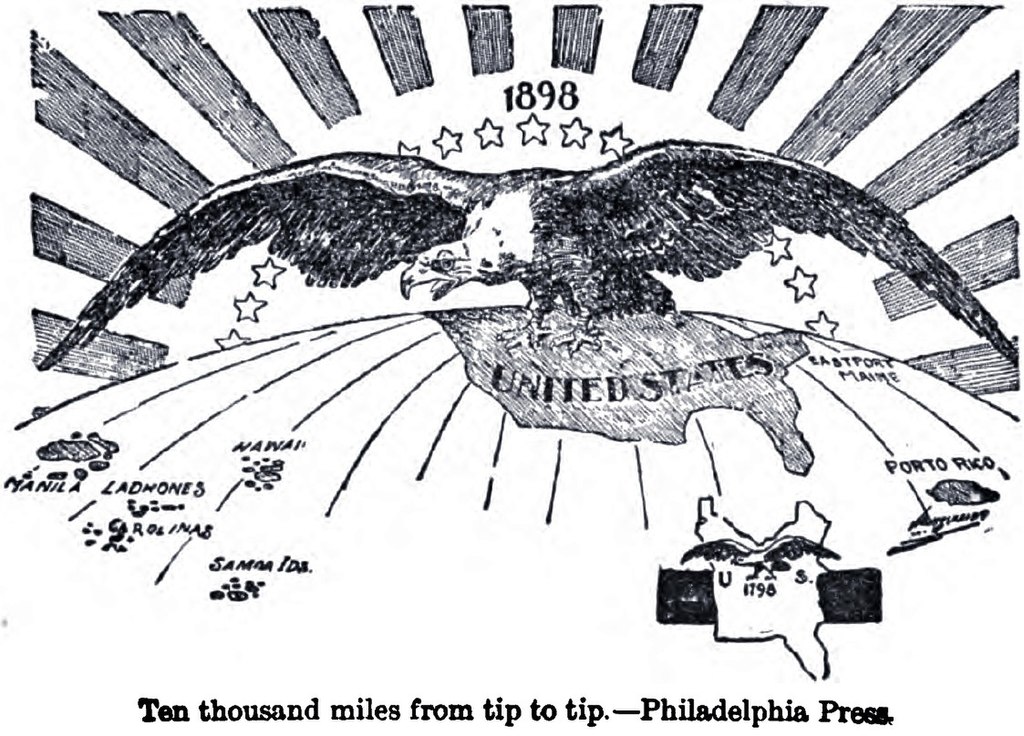
It is imperative that we come to terms with an increasingly glaring fact: the idea of America is dead. America as a global archetype of leadership is in decline. America’s crisis is not geopolitical but existential. The images of militarized police firing tear gas canisters evoke the image of power as violence. That is, without doubt, a form of power that we as Muslims are all too familiar with. There is, however, a more latent form of power that evades our gaze: it is the management of dissent. Power mediates dissent by “managing the threshold” through future-making, which in turn includes excluding other futures. This occurs when the horizon becomes absolute, the end of time as we know it, and the norm and natural order-of-things. It is the Real. It thrives not on an engineered “collective history” but rather on forgetting that the order is not an absolute and closed reality but a situation. It is to forget that the order and ‘eternal present’ is not natural but rather the expression of a will-to-power created not in the image of God but in the image of the powerful.
-
-
To properly situate such an exposition, we must turn to the underside of modernity and the concept of the ‘secular’ as a space of thought in order to understand how the ‘market’ came to be viewed as an autonomous and self-regulating space. Modernity is more than just a project of human self-assertion or the sovereignty of reason. The autonomy of human self-assertion is, in fact, possible only because modernity reoccupies the sovereignty of God with that of the dunyā. The autonomy of the “free-market” is possible only when we conceive of the dunyā as an autonomous sealed-off totality. That is to say, the sovereignty of God was replaced with a “surrogate form of transcendence” (Eagleton 2014, ix).
The sovereignty of the dunyā represents not the abandonment of sacralization but rather the absolutization and sacralization of the dunyā itself. The secular did not bring about a disenchantment of the world but its misenchantment. The world is enchanted by the animism and metaphysics of money and wealth. As such, neoliberal power forges the enchanted ‘secular’ as a space of thought and an iron-caged dunyā and its “market” as its space of action. As John Millbank reminds us that “once, there was no secular” and that the secular had to be imagined and created in both theory and practice. This process of automization was not limited to the natural world but was extended and forged for itself a new autonomous object: the economic as a field of “pure power.” The critical point to make here is that the “economic” was not a space waiting to be filled by the homo economicus —out there—already autonomous, only waiting to be occupied. Its autonomy had to be imagined before it could be occupied and closed onto itself, it had to be created ex nihilo. This, in turn, demanded a new fiction or “original covenant” which becomes “a sacred, unquestionable tale whereby a people is brought – or rather brings itself – into existence.”
-
To recall, in part one of this article I argued that secular power is pervasive because it operates at the level of cognition. It creates a sense of paralysis by conflating a secular situation with reality as the natural and insurmountable order of things. This, in turn, makes it impossible for consciousness to make the distinction between the [secular] world-as-it-is and an [alternate] world-as-it-ought-to-be. The brief mention of the notion that we must accommodate reality, in part one of this article, was intended to bring to fore another and perhaps the most powerful manifestation of power: reality-making. Let us expound on this notion of reality.
Secular Power and Reality-Making
As persons, we always find ourselves in a ‘situation’ be it familial, political, economic, and so forth. The situation can be favorable or unfavorable. To mediate these situations, we adopt an orientation predicated on an understanding of the situation and an envisioned course of action adjudicated against some normative or technical criteria. The situation is perceived to be contingent and surmountable, and as such, there exists the possibility of choice because we know that the situation could be otherwise. Reality, on the other hand, is not perceived to be a situation but rather merely the “way things are.” A reality is insurmountable and there is no perceived capacity for choice. A situation becomes a “reality” when we internalize an image of the self and the world as being normal and inevitable. This is an example of how power operates. The exercise of violence creates a situation but the exercise of formative power creates Reality. The Secular order does not present itself as one order among others, a historical or contingent possibility among other possibilities but as an inevitable and natural progression of reason as Reality. In internalizing its claims, we transform a colonial situation into a permanent and lived reality. (Read More)
-
The Muslim Ummah finds itself in a world that is not of its own making—a world that can be characterized as a Secular Age. In this context, how are we to navigate an increasingly complex landscape beset by secularity? More so, how are we to think about Muslim futures? In particular, how are we to think and act towards Muslim autonomy? How are we to reclaim an Islamic political consciousness in a secular age? These are among the most important questions that confront us. (Read More)
-

The story of the modern state can be told in several ways. However, the most glaring problem we face when attempting any sort of genealogical reconstruction of its origins is that we often speak through the language that is bequeathed to us by modernity, thus inhibiting any sort of sustained critique. This is evident in the ways we speak about nodal foundational modern concepts such as sovereignty. Rather than inquiring whose sovereignty, we need to critically re-examine the concept itself. In telling a story that accounts for concepts like sovereignty, we can also think through the possibility of a politics without sovereignty and the implications that such a politics would have on liberatory politics. Telling the story of modern sovereignty would illuminate the ways in which sovereignty is the product of a distinctly Eurocentric metaphysical imagination. The question before us, then, is as follows: what are the metaphysical assumptions that make the concept of sovereignty thinkable in the first place? Second, can we think about a politics without sovereignty? (Read More)
-

The long-standing and late Tunisian President Habib Bourguiba, who reigned over Tunisia for almost three decades, represents but one of the encroachments of the modern liberal order in the Muslim world. In the year 1960, as part of an ongoing secularisation effort, Habib Bourguiba declared that fasting in Ramaḍān hampered economic productivity and asked Muhammad b. ʿĀshūr, an esteemed scholar of the time, to issue a fatwa to justify the abandonment of the practice. Ibn ʿĀshūr went on public radio and responded:
“Prescribed for you is fasting” and announced, “God has spoken the truth and Bourguiba has spoken falsehood”.
This incident between Ibn ʿĀshūr and the secular elitist Habib Bourguiba came to represent a lofty illustration of the challenges that fasting – as a praxis – poses to the modern condition. In reminiscing over this incident, I was spurred to ask: how are we to make sense of this practice in an age of liberal hegemony – an act which is seemingly anomalous to the logic of economic productivity and progress? Read More
-

The problem of identity is largely about the question of who sets the terms of the debate. Muslims find themselves in the middle of a long-standing rift between conservative ideology on one hand and a liberal and leftist ideology on another. Among other issues, Islam and Muslims feature heavily in the on-going debate. As the debate stands now, Muslims are prevented from determining the terms of the debate. Muslims become the object of the debate and never the subjects. “Wavering between that (and this), (belonging) neither to these nor to those” (Q 4:143). What accounts for this state of wavering and what fruits will it bear for the Muslim self? What is our strategic advantage in such alliances? In this entry, I want to discuss how our alignment with the Left or Right amounts to a cruel optimism which as Lauren Berlant explains is “an optimistic attachment is cruel when the object/scene of desire is itself an obstacle to fulfilling the very wants that bring people to it.” It is cruel in the sense that there can be no representation and empowerment of the Muslim self if the self is lost in the process of pursuing that illusory optimism. (Read More)
-
A crisis is a turning point wherein an organism undergoes one of two changes; recovery or death. Put differently, it is the question of whether or not the organism’s internal capacities are strong enough to enable recovery without aid of an external mechanism. To illustrate, consider the average Covid-19 patient. The crisis does not depend on the patient’s access to a ventilator. The crisis begins at the point where we ask if recovery is possible without the ventilator. (See More)